Thermoelectricity
Due to the potential revolutionary impact on
economy and on the global energy challenge, thermoelectric
phenomena have already triggered tremendous research
interests worldwide. Yet available thermoelectric
materials to date still have very poor efficiency as compared
with compressor-based refrigerators. Fundamentally this is
because a comprehensive understanding of electron
transport, heat transport and their interplay is still
lacking. More research efforts should be devoted to
understanding how microscopic chaos and ergodicity,
disorder effects, and local thermalization are connected
with transport phenomena at different scales. We apply
extensively our expertise in nonlinear dynamics, complex
systems and statistical mechanics, our purpose being to
gain a better understanding of the physical mechanisms
which might lead to higher thermoelectric efficiencies.
For a review paper, see G.
Benenti, G. Casati, K. Saito and R. S. Whitney, Fundamental aspects of
steady-state coversion of heat to work at the
nanoscale, Phys. Rep. 694, 1-124 (2017).
Systems
with broken time-reversal symmetry
Three-dot model (left) for which the Seebeck and the Peltier coefficients are not symmetric
We have shown [2] that
for systems with broken time-reversal symmetry,
typically in presence of an applied magnetic field,
the maximum efficiency and the efficiency at
maximum power are both determined by two
parameters: a ``figure of merit'' and an asymmetry
parameter. In contrast to the time-symmetric case,
the figure of merit is bounded from above;
nevertheless the Carnot efficiency can be reached
at lower and lower values of the figure of merit
and far from the strong coupling condition as the
asymmetry parameter increases. Moreover, the
Curzon-Ahlborn limit for efficiency at maximum
power can be overcome within linear response. We
have shown that a weak magnetic field generally
improves either the efficiency of thermoelectric
power generation or of refrigeration, the
efficiencies of the two processes being no longer
equal when a magnetic field is added. Moreover, we
have shown [3] that when non-unitary noise effects
are taken into account the thermopower is in
general asymmetric under magnetic field reversal,
even for non-interacting systems. Our findings
have been illustrated in the example of a
three-dot ring structure pierced by an
Aharonov-Bohm flux. Finally, we have shown by
means of various models that the Curzon-Ahlborn
limit for the efficiency at maximum power can be
overcome within linear response [4].
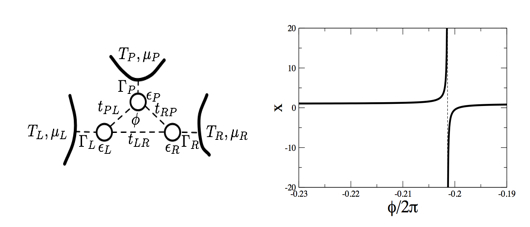
Three-dot model (left) for which the Seebeck and the Peltier coefficients are not symmetric
Non-integrable
systems with momentum conservation
We have shown
that for systems with a single relevant
constant of motion, notably momentum
conservation, the thermoelectric efficiency reaches
the Carnot efficiency in the thermodynamic limit [5].
Such general result is illustrated in the case of a
diatomic chain of hard-point elastically colliding
particles [5] as well as for a two-dimensional gas of
interacting particles [6] and for
particles in one dimension with screened Coulomb
interaction [7]. However. the Carnot limit can
be achieved for dissipationless heat engines.
Such ideal machines operate reversibly and
infinitely slowly, and therefore the extracted
power vanishes. For any practical puropose it is
therefore crucial to consider the
power-efficiency trade-off, in order to design
devices that work at the maximum possible
efficiency for a given output power. We show
that interacting systems can greatly overcome
the bound on the efficiency for a given power
valid for non-interacting systems [see R. S.
Whitney, Phys. Rev. Lett. 112, 130601 (2014)],
so that large efficiencies can be obtained
without greatly reducing power [8].

As a function of the system size, for a diatomic chain of hard-point elastically colliding particles: ballistic electrical conductivity,
saturation of the thermopower, anomalous thermal conductivity and divergence of the figure of merit.
Multi-terminal quantum
thermal machines
Schematic drawing of a
three-terminal thermal machine
We
have provided a general definition of local and
non-local transport coefficients. Within the Onsager
formalism and in the three-terminal case, we have
derived analytical expressions for the efficiency at
maximum power, which can be written in terms of
generalized figures of merit. Also, using two
examples (single and double dot), we have
investigated numerically how a third terminal could
improve the performance of a quantum system, and
under which conditions non-local thermoelectric
effects could be observed [9]. The general
theoretical framework developed in [9] has been
applied to separate charge and heat flows in a
three-terminal structure, thus boosting
thermoelectric performances [10] and to management
of heat flows by switching a magnetic field (heat
current multiplier, reversal,
swap, on/off switch) [11]. Furthermore, the multi-terminal
setup has been investigated in the context of an
interacting, multilevel quantum dot coupled to electronic
reservoirs, focusing on the sequential tunneling regime
[12].

Onsager reciprocal relations with broken time-reversal symmetry
We have provided [13]
analytical and numerical evidence that Onsager
reciprocal relations remain valid for systems with
broken time-reversal symmetry as is typically the case
when a generic magnetic field is present. Our results
show that the Onsager reciprocal relations are much
more general than previously assumed. Hence, the
fundamental constraints they impose on heat to work
conversion remain valid also with broken time-reversal
symmetry. In particular, the possibility of an engine
operating at the Carnot efficiency with finite power
is ruled out on purely thermodynamic grounds.
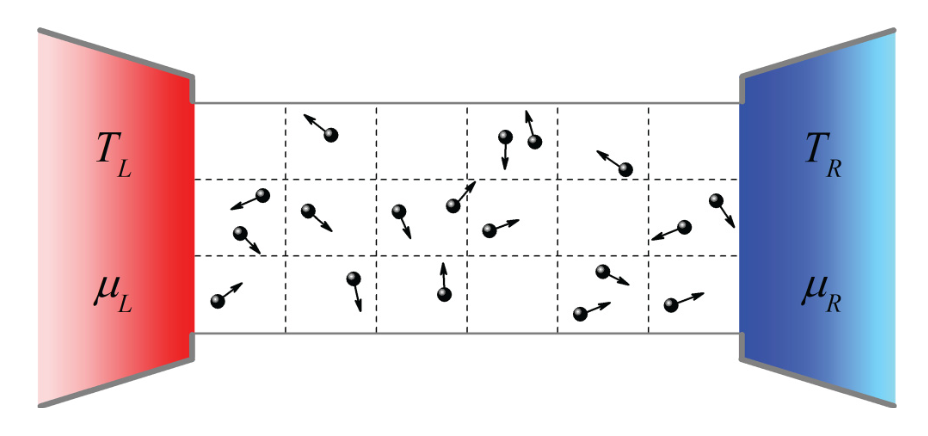
Multiparticle collision method to simulate coupled transport in a magnetic field
Power, efficiency, and fluctuations in steady-state heat engines
We have considered [14] the quality factor Q, which quantifies the trade-off between power, efficiency, and fluctuations in steady-state heat engines modeled by dynamical systems. We have shown that the nonlinear scattering theory, in both classical and quantum mechanics, sets the bound Q = 3/8 when approaching the Carnot efficiency. On the other hand, interacting, nonintegrable, and momentum-conserving systems can achieve the value Q = 1/2, which is the universal upper bound in linear response. This result shows that interactions are necessary to achieve the optimal performance of a steady-state heat engine.
Multiparticle collision method to simulate coupled transport in a magnetic field
Power, efficiency, and fluctuations in steady-state heat engines
We have considered [14] the quality factor Q, which quantifies the trade-off between power, efficiency, and fluctuations in steady-state heat engines modeled by dynamical systems. We have shown that the nonlinear scattering theory, in both classical and quantum mechanics, sets the bound Q = 3/8 when approaching the Carnot efficiency. On the other hand, interacting, nonintegrable, and momentum-conserving systems can achieve the value Q = 1/2, which is the universal upper bound in linear response. This result shows that interactions are necessary to achieve the optimal performance of a steady-state heat engine.
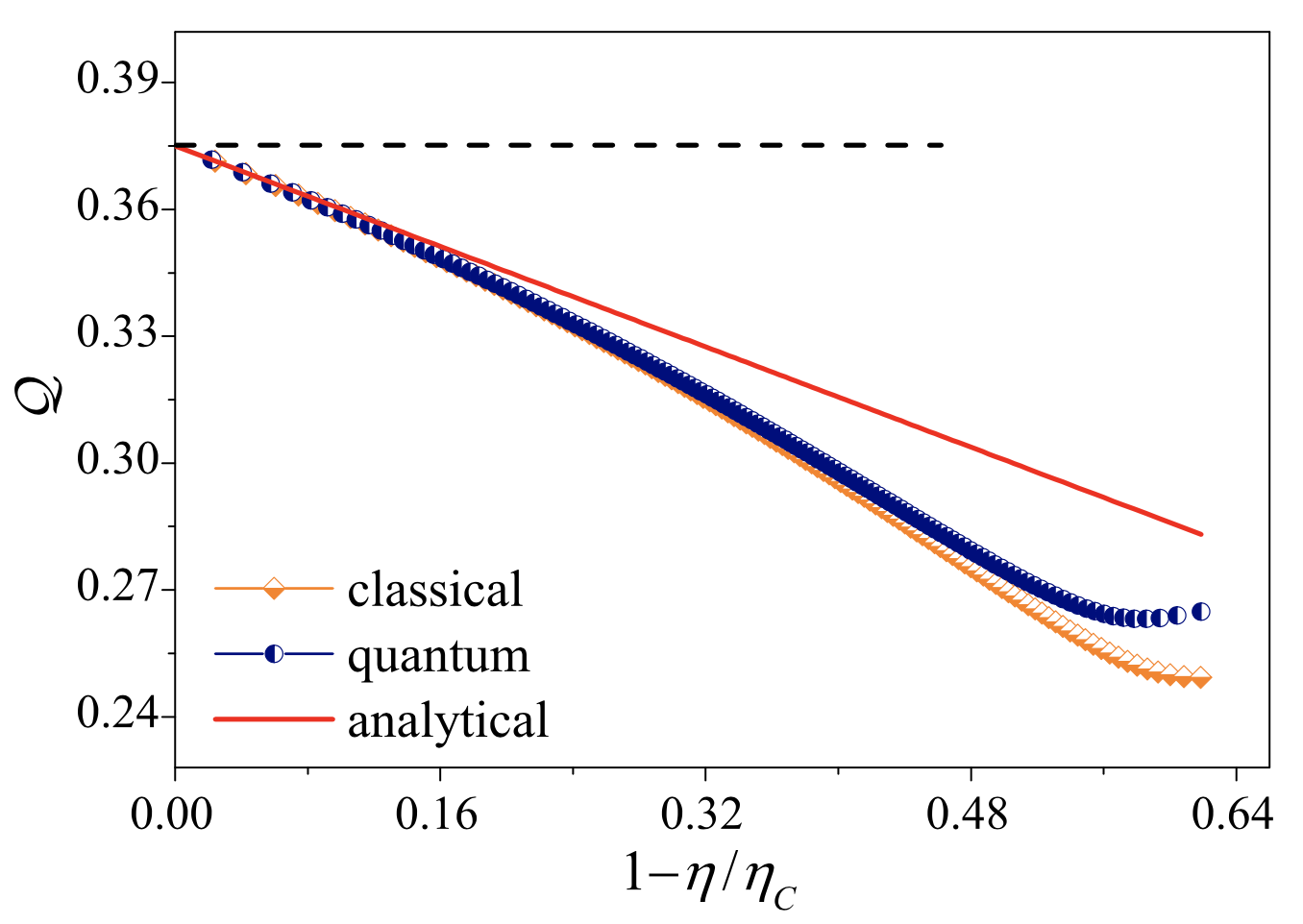
Bound for power-efficiency-fluctuations trade-off within scattering theory
References
[1] K. Saito, G. Benenti and G. Casati, A microscopic mechanism for increasing thermoelectric efficiency, Chem. Phys. 375, 508 (2010).
[1] K. Saito, G. Benenti and G. Casati, A microscopic mechanism for increasing thermoelectric efficiency, Chem. Phys. 375, 508 (2010).
[2] G. Benenti, K. Saito and G. Casati, Thermodynamic bounds on
efficiency for systems with broken time-reversal
symmetry, Phys. Rev. Lett. 106, 230602 (2011).
[3] K. Saito, G. Benenti, G. Casati and T. Prosen, Thermopower with broken time-reversal symmetry, Phys. Rev. B 84, 201306(R) (2011).
[4] V. Balachandran, G. Benenti and G. Casati, Efficiency of three-terminal thermoelectric transport under broken time-reversal symmetry, Phys. Rev. B 87, 165419 (2013).
[5] G. Benenti, G. Casati and W. Jiao, Conservation laws and thermodynamic efficiencies, Phys. Rev. Lett. 110, 070604 (2013) [marked as an Editors' suggestion].
[6] G. Benenti, G. Casati and C. Mejia-Monasterio, Thermoelectric efficiency in momentum-conserving systems, New J. Phys. 16, 015014 (2014).
[7] S. Chen, J. Wang, G. Casati and G. Benenti, Thermoelectricity of interacting particles: A numerical approach, Phys. Rev. E 92, 032139 (2015).
[8] R. Luo, G. Benenti, G. Casati and J. Wang, The best thermoelectric: The role of interactions, preprint arXiv:1710.06646 [cond-mat.stat-mech].
[9] F. Mazza, R. Bosisio, G. Benenti, V. Giovannetti, R. Fazio, and F. Taddei, Thermoelectric efficiency of three-terminal quantum thermal machines, New J. Phys. 16, 085001 (2014).
[10] F. Mazza, S. Valentini, R. Bosisio, G. Benenti, V. Giovannetti, R. Fazio and F. Taddei, Separation of heat and charge currents for boosted thermoelectric conversion, Phys. Rev. B 91, 245435 (2015).
[11] R. Bosisio, S. Valentini, F. Mazza, G. Benenti, R. Fazio, V. Giovannetti and F. Taddei, Magnetic thermal switch for heat management at the nanoscale, Phys. Rev. B 91, 205420 (2015) [marked as an Editors' suggestion].
[12] P. A. Erdman, F. Mazza, R. Bosisio, G. Benenti, R. Fazio and F. Taddei, Thermoelectric properties of an interacting quantum dot based heat engine, Phys. Rev. B 95, 245432 (2017).
[13] R. Luo, G. Benenti, G. Casati and J. Wang, Onsager symmetry for systems with broken time-reversal symmetry, Phys. Rev. Res. 2, 022009(R) (2020).
[14] G. Benenti, G. Casati and J. Wang, Power, efficiency, and fluctuations in steady-state heat engines, Phys. Rev. E 102, 040103(R) (2020).
[3] K. Saito, G. Benenti, G. Casati and T. Prosen, Thermopower with broken time-reversal symmetry, Phys. Rev. B 84, 201306(R) (2011).
[4] V. Balachandran, G. Benenti and G. Casati, Efficiency of three-terminal thermoelectric transport under broken time-reversal symmetry, Phys. Rev. B 87, 165419 (2013).
[5] G. Benenti, G. Casati and W. Jiao, Conservation laws and thermodynamic efficiencies, Phys. Rev. Lett. 110, 070604 (2013) [marked as an Editors' suggestion].
[6] G. Benenti, G. Casati and C. Mejia-Monasterio, Thermoelectric efficiency in momentum-conserving systems, New J. Phys. 16, 015014 (2014).
[7] S. Chen, J. Wang, G. Casati and G. Benenti, Thermoelectricity of interacting particles: A numerical approach, Phys. Rev. E 92, 032139 (2015).
[8] R. Luo, G. Benenti, G. Casati and J. Wang, The best thermoelectric: The role of interactions, preprint arXiv:1710.06646 [cond-mat.stat-mech].
[9] F. Mazza, R. Bosisio, G. Benenti, V. Giovannetti, R. Fazio, and F. Taddei, Thermoelectric efficiency of three-terminal quantum thermal machines, New J. Phys. 16, 085001 (2014).
[10] F. Mazza, S. Valentini, R. Bosisio, G. Benenti, V. Giovannetti, R. Fazio and F. Taddei, Separation of heat and charge currents for boosted thermoelectric conversion, Phys. Rev. B 91, 245435 (2015).
[11] R. Bosisio, S. Valentini, F. Mazza, G. Benenti, R. Fazio, V. Giovannetti and F. Taddei, Magnetic thermal switch for heat management at the nanoscale, Phys. Rev. B 91, 205420 (2015) [marked as an Editors' suggestion].
[12] P. A. Erdman, F. Mazza, R. Bosisio, G. Benenti, R. Fazio and F. Taddei, Thermoelectric properties of an interacting quantum dot based heat engine, Phys. Rev. B 95, 245432 (2017).
[13] R. Luo, G. Benenti, G. Casati and J. Wang, Onsager symmetry for systems with broken time-reversal symmetry, Phys. Rev. Res. 2, 022009(R) (2020).
[14] G. Benenti, G. Casati and J. Wang, Power, efficiency, and fluctuations in steady-state heat engines, Phys. Rev. E 102, 040103(R) (2020).